

Making Bitcoin Speak Human
Spiral has supported FOSS bitcoin since 2019, making bitcoin everyday money by improving security, privacy, and especially UX. That’s why we’re focused on how the next wave of users spend bitcoin.


If you’ve ever sent a true peer-to-peer bitcoin payment, you know how anxiety-inducing it can be. We copy and paste these weird-looking pieces of text into our wallets, hope we didn’t mistakenly replace a character due to a fat finger, and pray the coins don’t end up in limbo.
Human Bitcoin Addresses (HBAs), the name we’re proposing for the BIP 353 standard, bring the familiar, intuitive payment experiences of apps like Cash App, Venmo, and PayPal to bitcoin. Instead of dealing with long, intimidating wallet addresses, HBAs make sending bitcoin as simple as sending an email.
As an open industry standard built on the Domain Name System (DNS), BIP 353 transforms addresses that look like “bc1q0zv3j4kzv…” into something for humans, like ₿conorokus@twelve.cash. That’s a big win for usability, helping cut down on mistakes made while copying and pasting, or scaring people from making transactions at all.
DNS is familiar and already part of how we use the Internet. It’s the powerful naming system that computers use to talk to one another, translating domain names (like www.google.com) into IP addresses like (142.251.16.100). When someone types a name into a browser, they are relying on this system. We can use it to achieve a similar effect in bitcoin but for payments.
Send money to names, not random characters.
Names in payment apps are convenient, legible, and memorable. Think $judysmith or @moneyball. They act as a UX bridge, hiding much of the underlying complexity like identity, compliance rules, payment rails, and everything in between.
The problem is that today’s naming systems are fully centralized and not interoperable. A Cash App $cashtag can’t receive PayPal payments and a PayPal username can’t receive Venmo payments.
Bitcoin is powerful but still feels hard to use.
As a technology, bitcoin was built to be decentralized, open, and global, but we still “address” people in ways that feel completely foreign to humans:
“Send me your on-chain address.” This requires scrutinizing, then copying and pasting a short string of random-looking characters.
“Send me a Lightning invoice.” This requires scrutinizing, then copying and pasting a much longer string of random characters.
Non-bitcoiners don’t talk like this when they’re sending money, which is why this could be a make-or-break moment for bitcoin adoption. We’re staring straight at one of the most important UX questions in bitcoin: Can we create a human-friendly addressing system that preserves bitcoin’s core properties?
It’s a big question, and getting it right could unlock the next wave of users while removing a significant barrier to adoption.
Solving a major peer-to-peer hurdle.
The headline use case for HBAs is that they make bitcoin payments interoperable not only across the entire ecosystem but also between different L1 and L2 payment protocols. They let you send bitcoin instantly and privately from any wallet or exchange to any other wallet or exchange without coordination or a special setup.
But HBAs can also be used to improve automatic sweeps. They can let you move funds from a custodian to your own wallet safely, privately, and without friction—all while avoiding address re-use. It’s a simple path from “I bought bitcoin” to “I control my bitcoin.”
Finally, when you’re checking a recipient’s address on a hardware wallet, HBAs make the process clearer and less error-prone. It’s much easier to confirm a short name you recognize than to scan a long string of characters.
Under the hood of Human Bitcoin Addresses.
An HBA can be used to receive bitcoin, no matter which payment protocol is involved. It works by pointing to a BIP 321 URI stored in secure DNS records, letting HBAs run on top of the internet infrastructure we already have. They use the same global, battle-tested DNS system that powers the web: every time you type a URL into your browser, you’re doing a DNS lookup without knowing it. So this is familiar territory for wallets.
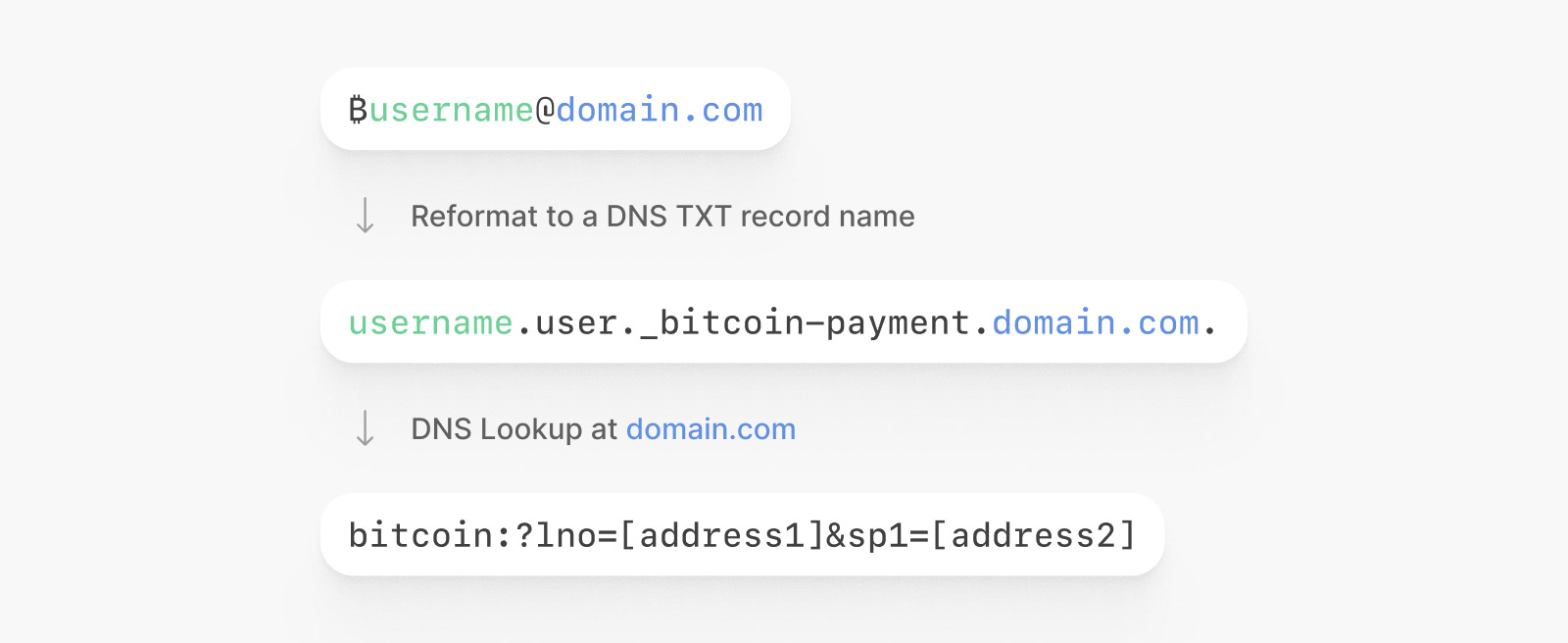
To make this concrete, imagine Bob wants to receive some bitcoin.
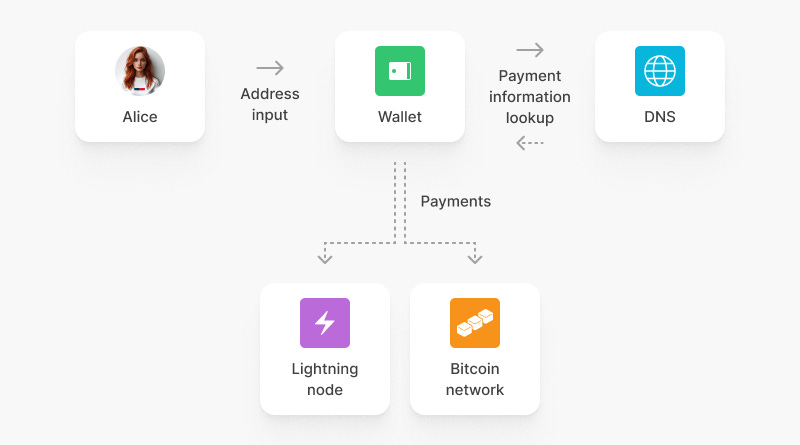
It could go something like this: first, Bob’s wallet or service helps him set up a Human Bitcoin Address. Behind the scenes, his payment instructions, like a BOLT 12 offer, are stored securely in DNS. Then, if Alice wants to pay Bob, she doesn’t need to ask for an invoice or coordinate anything in real time. Bob shares his HBA with her however he likes: in a text message, over a call, on his website, on a business card—it doesn’t matter. When Alice enters Bob’s address, her wallet automatically looks up Bob’s payment info from DNS, fetches the BOLT 12 offer, and prepares the payment for her. With one tap, her wallet sends the payment across the Lightning Network.
And with async payment protocol support (recently made available in LDK 0.2), it doesn’t even matter if Bob is offline. When his node or service comes online, it settles, and the funds are his. All of this happens without centralized servers, Bob needing to be online, or either party doing anything beyond sharing a simplified address.
Preserving bitcoin’s bitcoinness.
Perhaps the most important thing about HBAs is the fact they are a UX unlock that helps bitcoin scale to everyday use without sacrificing the qualities that make bitcoin bitcoin. Here’s how HBAs stay true to bitcoin’s vision:
Privacy: There’s no third-party server that can track payment information like sender, amounts and metadata.
Censorship resistance: Because no central server sits in the middle, there’s nothing that can block, filter, or freeze your payment.
Security: This design eliminates the risk of a server inserting their own invoices and stealing funds. And DNSSEC protects the payment instructions themselves, ensuring they can’t be spoofed.
Interoperability: HBAs open closed payment silos and enable cross-ecosystem work. They can unify and integrate other payment protocols under one human-readable name.
HBAs bring bitcoin’s usability up without dragging its principles down.
HBAs are the ultimate bitcoin identifier.
Because they sit above other addressing schemes, a BIP 353 HBA has the potential to become the most interoperable, future-proof identifier a user will ever need.
A solution like this has been needed for a long time. But now, as bitcoin payments are preparing to scale and new protocols are emerging with their own naming formats (like Spark and Ark and surely more to come), it matters even more. Without a unifying standard, the ecosystem risks splintering into incompatible addressing schemes and confusing UX patterns.
HBAs give the industry a chance to align on one simple, human-friendly identifier that can work across every protocol and for every user.
What about Lightning Addresses?
Lightning Addresses (via the LNURL protocol) are similarly human-readable addresses that emerged years ago—prior to the existence of BIP 353—to solve a similar UX need, but in a way that required two big compromises:
Trusting third-party servers meant having them surveil who you pay, censor who you’re allowed to pay, or even steal funds in certain setups. That’s not how bitcoin scales to everyone.
They’re Lightning-only and aren’t built to interoperate with other protocols or on-chain payments (like Ark, Spark, Cashu and Silent Payments). LNURL locks users into a single part of the ecosystem.
Lighting Addresses can be thought of as a stopgap measure that has served its purpose; one the ecosystem can finally move on from. With BIP 353 + BOLT 12 we now have a human-readable addressing system with the same ease of use without the centralization, trust, or interoperability limitations.
The industry as it exists today.
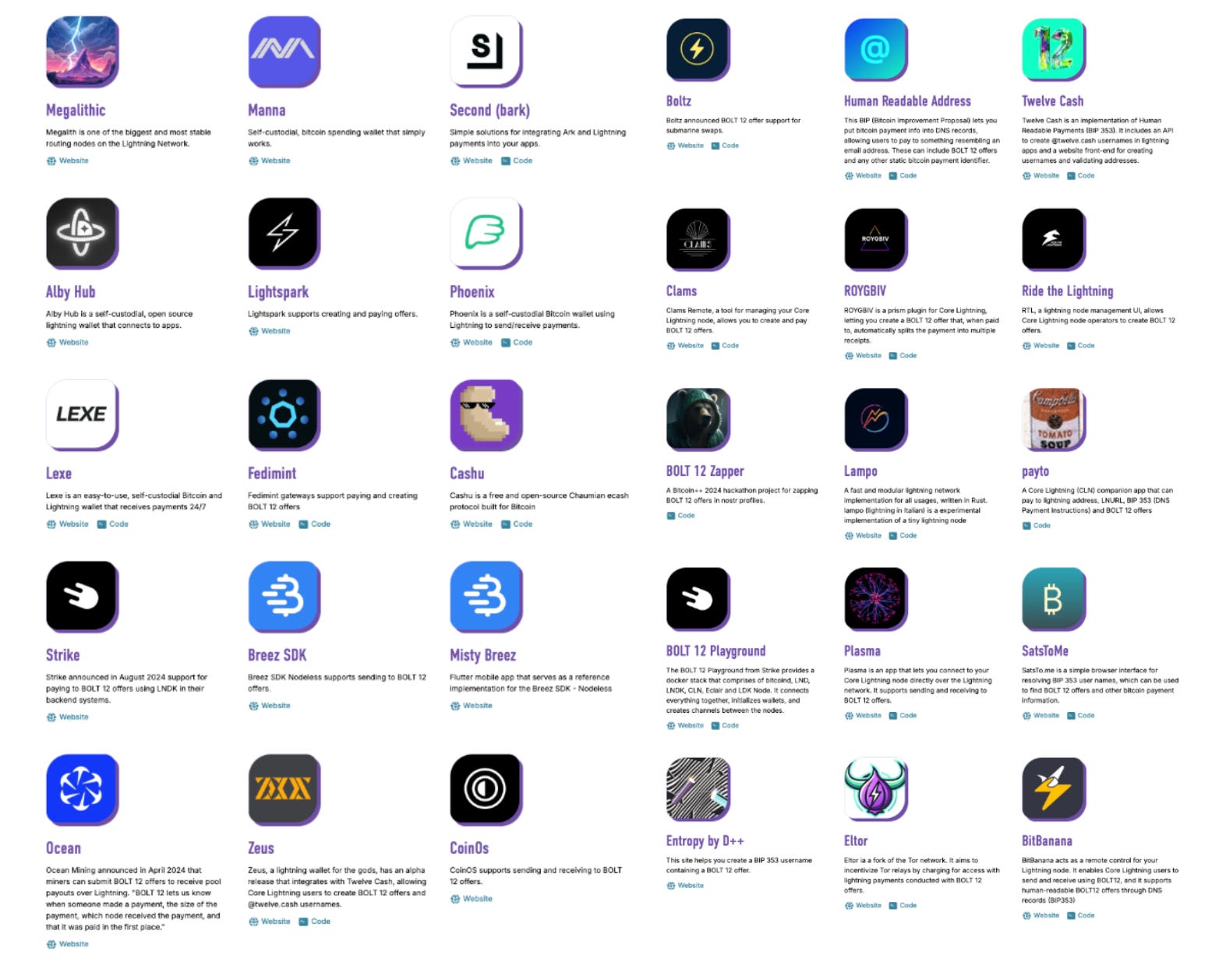
So now that we have a better solution, the time has come to push HBAs toward large-scale adoption. Phoenix—arguably the leading self-custodial mobile spending wallet—shipped full send and receive HBA support in 2024 (find it under Settings > Experimental). Already dozens of wallets and bitcoin applications support sending to BOLT 12. Cash App (with its 57M active users) has signaled they are building support for it as well. Momentum is building and we’re eager to see more wallets and bitcoin products come onboard.
Here’s what we think of as the practical path to supporting Human Bitcoin Addresses in your app:
Adopt BIP 321 as the common addressing format
Enable support for BIP 321 URIs as the unified way to express payment instructions across protocols, creating a consistent foundation for interoperability and future-proofing. Encouragingly this is already supported by the vast majority of wallets and exchanges but a handful of notable exceptions remain.
Enable sending to BOLT 12 and HBAs
This is a relatively light lift for most wallets and services and has minimal UX impact. The goal is simple: make it possible for your users to pay anyone who has an HBA, regardless of wallet or network. Just doing this much creates a ton of value for the network and your users. Many wallets and apps across the ecosystem have already added the prerequisite BOLT 12 support, preparing the groundwork for adding HBA next.
Enable receiving via BOLT 12 and HBAs
This unlocks even more value, as your users can now receive bitcoin at a stable, memorable and interoperable address—at your domain. It does require DNSSEC to be implemented at your DNS provider, plus backend and UX work (e.g., username selection, managing offers), but it’ll be worth it, so your users can share their HBAs everywhere
One day, bitcoin won’t feel like a niche, complex financial tool. It will feel invisible and effortless. Payments will flow across apps, countries, and currencies through human-readable names. When that happens, users won’t think about protocols, rails, or layers. In fact, they won’t have to think about much of anything, which is how it should be.
To start making payments with Human Bitcoin Addresses, download the Phoenix wallet, where you’ll be able to experience the magic firsthand. If you’re more technical and would like to implement your own self-hosted HBA solution, check out this tutorial.
This is the kind of Bitcoin education (and development) that the world needs!